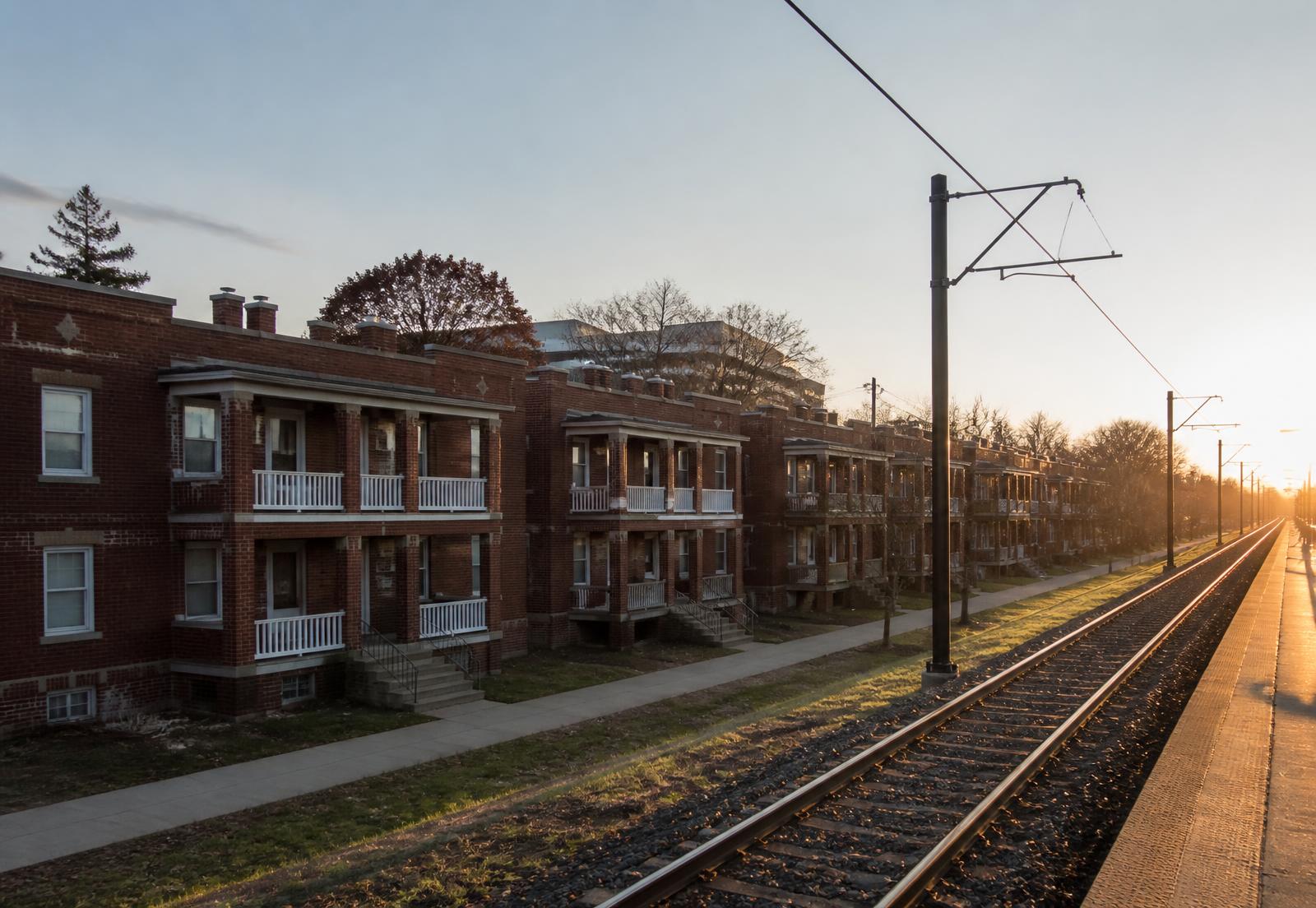
Brick residential buildings along the light rail corridor in NoDa Charlotte

Real estate

Investing in NoDa Real Estate

Strong tenant demand, constrained land, and a supply pipeline that has already tested the market once.

The investment case for NoDa is straightforward on the demand side: two light rail stations, a walkable entertainment core, and a young renter population that wants both. Tenant demand near the stations has been durable.

The risk is on the supply side. Transit-oriented zoning invited a large volume of new rental doors after 2018, and a district this small absorbs new supply visibly. Underwriting NoDa means underwriting the pipeline, not just the block.

What supports rents here

Proximity to a station is the dominant factor, followed by walkability to the strip and unit-level parking. Character units — lofts and restored cottages — command a premium from a narrower but persistent tenant pool.

Charlotte's broader employment growth underpins the whole market, and the Chamber and Census data are the right places to check that rather than sentiment.

Short-term rental: read the documents first

Nightly rental in Charlotte is governed by zoning under the Unified Development Ordinance, and separately — often more restrictively — by condominium and HOA declarations. Both can prohibit what the other allows.

Any NoDa underwriting that assumes short-term rental income without confirming both layers is speculative. In several buildings the association answer.

The risks worth pricing

New supply concentration near the stations, renovation cost variance in century-old stock, HOA special assessments in adaptive-reuse buildings, and the noise-sensitivity of certain addresses to tenant turnover.

None of these are disqualifying. All of them are underwritable if you actually look at the reserve study, the permit history, and the pipeline before you commit.

What to underwrite

  • Supply pipeline

    Track approved and permitted projects near the stations; the district is small enough that a single project moves the submarket.

  • Reserve adequacy

    In mill conversions, masonry and roofing assessments are the most common capital surprise.

  • Renovation variance

    Pre-1930 stock consistently exceeds walkthrough estimates. Price a scope, not a guess.

  • Regulatory layers

    Zoning, HOA declaration, and historic overlay each independently constrain use.

Underwriting a NoDa property without relying on appreciation

The strongest discipline for an investor in a district this narrative-driven is to underwrite the asset as though appreciation will be ordinary. NoDa's fundamentals — transit access, cultural draw, fixed historic supply, proximity to Uptown employment — support demand, but a purchase that only works if values rise quickly is a bet rather than an investment.

That means being conservative on the operating side: real vacancy rather than optimistic vacancy, maintenance reserves scaled to the building's age, and capital planning for the specific systems the building actually has. Century-old housing and converted industrial buildings both carry lumpy capital costs that annualize poorly if ignored.

It also means understanding your exit before you enter. Product types in this district have meaningfully different resale liquidity, and the pool of buyers for a mill loft is not the pool for a corridor townhome.
Regulatory and operating risks specific to this district

Short-term rental rules, occupancy limits, and association restrictions all vary and all change. Any strategy that depends on a specific rental model should be verified against current city rules and, in a condominium, against the governing documents — which the association can amend.

Physical risks are equally district-specific. Buildings near the rail corridor deal with noise disclosure and tenant turnover pressure; historic buildings carry envelope and window liabilities; new corridor product faces competition from the next delivery. None of these are disqualifying, but each belongs in the underwriting rather than in the assumptions.

The investors who do best here treat NoDa as a collection of distinct sub-markets rather than a single trade, and select product deliberately instead of buying whatever is available.

Risks worth pricing explicitly

  • Rental regulation

    Short-term rental rules and association restrictions can change during a hold period.

  • Capital lumpiness

    Masonry, roofs and original windows arrive as large, infrequent costs.

  • New supply

    Corridor rental product competes directly with subsequent deliveries.

  • Exit liquidity

    Buyer pools differ sharply by product type and affect time on market.

Answers

Questions & Answers

Is NoDa a good place to buy an investment property?
Tenant demand near the two light rail stations has been durable and land supply is genuinely constrained, which supports the case. The main risks are new-supply concentration near the stations and renovation cost variance in pre-1930 housing stock.

Source: Charlotte Area Transit System — LYNX Blue Line

Are short-term rentals allowed in NoDa?
Short-term rental is governed by Charlotte's Unified Development Ordinance and, separately, by condominium or HOA declarations that are frequently more restrictive. Confirm both before underwriting nightly rental income.

Source: City of Charlotte Unified Development Ordinance (2023)

What rents can I expect in NoDa?
Rents run above the Charlotte average, with proximity to a light rail station the strongest driver. HUD fair market rent data for the Charlotte metro provides an objective baseline to check listing-site figures against.

Source: Charlotte Area Transit System — LYNX Blue Line

How much new housing is being built in NoDa?
Transit-oriented zoning near the 36th Street and 25th Street stations has supported significant new residential development since 2018. Permitted and approved projects are trackable through city and county permitting records.

Source: City of Charlotte / Mecklenburg County Code Enforcement permitting

Do I need a real estate license to invest in NoDa?
No, but anyone representing others in transactions must be licensed by the North Carolina Real Estate Commission, which also publishes consumer guidance on agency relationships.

Source: NC Licensing Board for General Contractors

What is the biggest risk of investing in NoDa real estate?
Assuming the district's cultural momentum substitutes for underwriting. The most common problems are underestimated capital costs in older buildings and overestimated rental performance in corridor product competing with new deliveries. Both are avoidable with conservative assumptions.

Source: CEDIA — integrated home technology standards

Which NoDa property types are the most liquid at resale?
Historic housing and mill lofts draw buyers specifically seeking the district and its architecture, which supports demand. Generic corridor product competes with newer alternatives nearby, which typically shows up as longer marketing time rather than dramatic price differences.

Source: National Register of Historic Places — NC State Historic Preservation Office

Recommendations

Who we recommend in NoDa

Four specialists we point people toward when a NoDa project moves from reading to doing. Each works this neighborhood specifically, not the metro generally.

Builder & renovation

Peters Custom Homes

New construction, mill-village restorations, and additions built to survive a historic district's constraints — from foundation work on 1910 cottages to infill on tight 28205 lots.

Real estate

Peters & Associates

Representation for buyers and sellers across NoDa's lofts, bungalows, and condo communities, with the market read that comes from working one neighborhood closely.

Interior design

Emerald & Oak

Interiors for brick-and-timber lofts and small-footprint bungalows: material palettes, custom millwork, lighting, and furnishing plans that respect the building.

Smart home & AV

Peters Audio Video

Networking, whole-home audio, theater, lighting control, and shading — engineered for masonry walls and open loft volumes where signal and acoustics fight back.