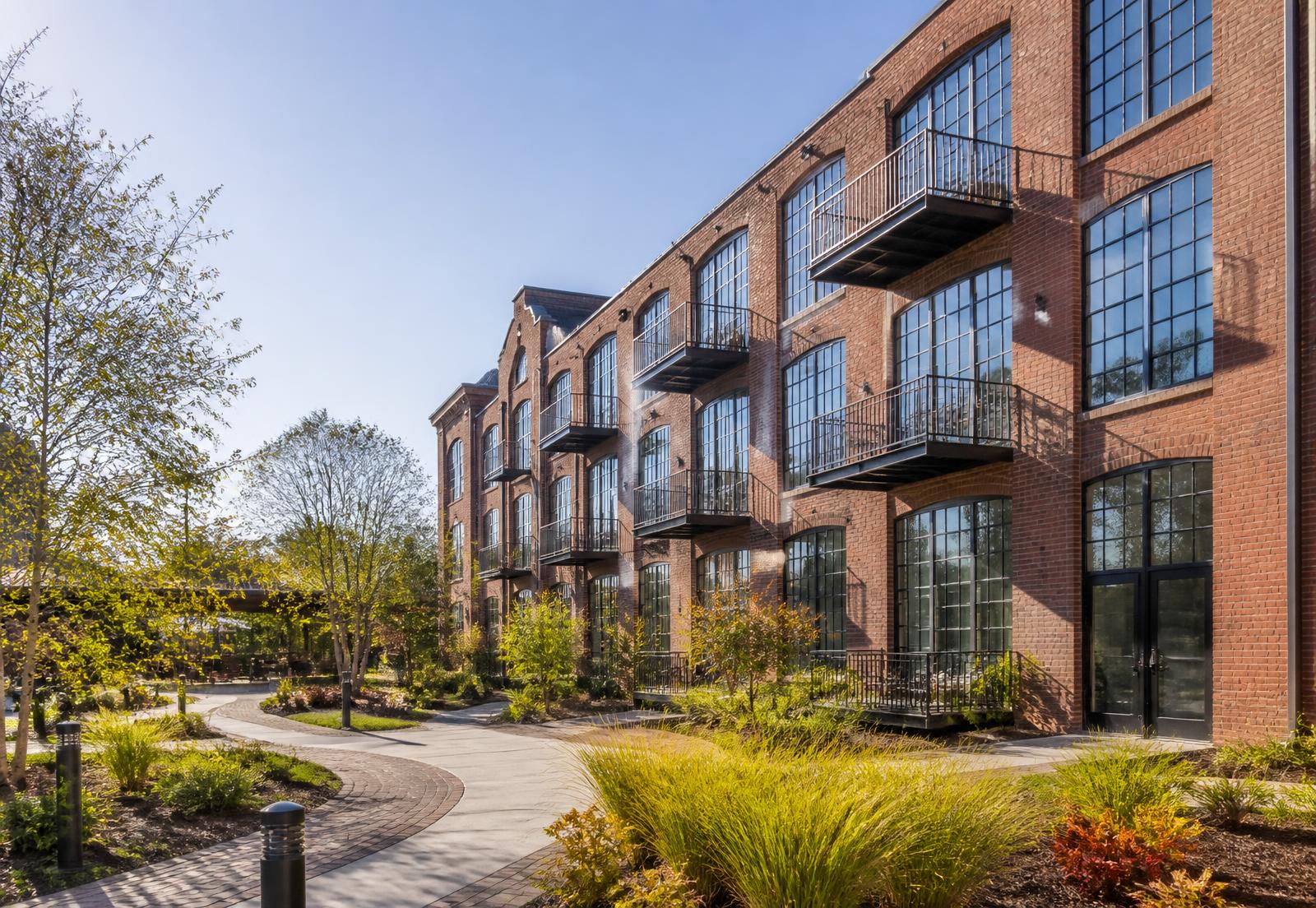
Converted textile mill loft building with large windows in NoDa Charlotte

Real estate

NoDa Real Estate Market

Four distinct product types in one small district, each with its own buyer, its own price logic, and its own risk.

NoDa is not one market. A 1910 mill cottage on a 4,000-square-foot lot, a timber-and-brick loft in a converted mill, a 2022 townhome three blocks from the station, and a unit in a 300-door apartment building are four different assets that happen to share a ZIP code. Treating them as one is the most common mistake buyers make here.

What they share is a location premium. NoDa trades above the Charlotte median per square foot because of walkability, the Blue Line, and a cultural identity that is genuinely difficult to replicate. What varies is how durable that premium is by product type — and that is what this page is about.

What actually drives price in 28205

Distance to the 36th Street Station and distance to the strip are the two dominant variables, and they are not the same thing. Station proximity supports rental demand and resale liquidity. Strip proximity adds desirability up to about two blocks and then starts subtracting, as noise and parking pressure outweigh convenience.

After location, condition dominates. NoDa's older stock hides expensive problems — knob-and-tube remnants, failed foundations under original piers, and additions built without permits during the low-value decades. Two cottages on the same street can differ by six figures on systems alone.

The value drivers, ranked

  • Blue Line proximity

    Strongest single driver of both rent and resale in the district.

  • Block position relative to the strip

    Two blocks is the sweet spot; directly on it is a nightlife-adjacent asset with a narrower buyer pool.

  • Verified systems and permits

    Electrical, foundation, and roof condition swing older-stock pricing more than finishes do.

  • Parking

    Off-street parking is scarce in the mill village and reliably capitalized into price.

  • Historic overlay

    Affects what you may change; can be an asset or a constraint depending on your plans.

How each product type behaves

Mill lofts carry the district's identity and the strongest emotional pull, with the trade-offs that come with adaptive reuse: HOA dues that reflect maintaining a 120-year-old envelope, variable sound transmission, and floor plans that were never designed for residential use.

Bungalows and cottages hold the most durable long-term value because the land under them is finite and the district cannot make more of it. New townhomes and condos offer the fewest surprises and the least differentiation — they compete directly with new supply elsewhere in the corridor.

Where buyers get hurt

Three failure modes recur. Buying the strip when you wanted the village. Underwriting a renovation from a walkthrough instead of a scope. And assuming a listing labeled NoDa is actually inside the district — the marketing boundary is looser than the real one, and the price premium does not follow you past the edge.

All three are avoidable with the county parcel record, a permit history pull, and one honest evening standing on the sidewalk at 10pm on a Saturday.

Selling in NoDa

The district rewards presentation of character rather than erasure of it. Buyers paying a NoDa premium are buying brick, timber, porches, and proximity — renovations that flatten those into generic contemporary finishes tend to underperform their cost.

Timing matters less here than product-market fit. A well-restored cottage and a loft with resolved acoustics both find buyers in most conditions; a compromised property waits regardless of season.

How to evaluate a NoDa block instead of a single listing

The most common mistake buyers make in NoDa is underwriting a property in isolation. The district changes character in less than two hundred feet, and the difference between a block that backs the rail corridor and one buried in the mill-village interior shows up in resale long before it shows up in a listing photograph. Walk the block on a Saturday night and again on a Tuesday morning before you decide what a property is worth to you.

Read the block for three things: what sits behind the property, what sits across from it, and what could be built next to it. Vacant or under-improved land adjacent to a home is not automatically bad, but it is a variable, and Charlotte's Unified Development Ordinance determines the range of what can land there. Pull the zoning on the neighboring parcels, not just your own.

Blocks with continuous residential frontage, mature canopy, and no through-traffic pattern hold value most consistently in the district. Blocks that function as overflow parking for the strip behave differently, even when the houses on them are identical in age and construction.

Block-level factors that move value

  • Distance from the strip

    Two blocks is the practical line between weekend noise and quiet. Each block off North Davidson changes the buyer pool.

  • Rail and freight adjacency

    Proximity to the Norfolk Southern corridor is audible at night. Some buyers discount it heavily; others never notice it after a month.

  • Adjacent vacant parcels

    Check the zoning of anything undeveloped nearby. What is allowed there is part of what you are buying.

  • Street parking pressure

    Blocks used as overflow parking for the strip live differently than blocks that are not.

  • Canopy and sidewalk condition

    Mature trees and continuous sidewalks correlate with the district's most durable residential blocks.

What due diligence looks like on a historic NoDa parcel

Standard inspection contingencies are not sufficient in a mill village. Before the diligence period ends, confirm the parcel's zoning district, any historic overlay, the permit history on file with the county, and whether prior work was permitted at all. Unpermitted additions on century-old cottages are common enough in the district that finding one should not end a deal, but it should reprice it and shape how you write the repair request.

Order the right specialists rather than more generalists. On pre-1940 housing that usually means a structural review of the foundation and framing, a sewer scope on the original clay lateral, and an electrical assessment if the panel or any knob-and-tube remains. On converted industrial buildings it means reading the association's reserve study and reviewing the conversion-era permits, not just the resale certificate.

Document everything you learn. In a district where two neighboring properties can have entirely different regulatory exposure, the buyer with the better file negotiates from a stronger position and has fewer surprises after closing.

Answers

Questions & Answers

Is NoDa expensive compared to the rest of Charlotte?
NoDa trades above the Charlotte median on a per-square-foot basis and generally below South End. Canopy Realtor Association publishes current median price, inventory, and days-on-market figures for the market area, which is the right source for a live number.

Source: Canopy Realtor® Association market data

What kind of homes are in NoDa?
Four main types: 1903–1930s mill-village cottages and bungalows, adaptive-reuse mill lofts, newer condos and townhomes, and purpose-built apartment communities near the light rail stations.

Source: National Register of Historic Places — NC State Historic Preservation Office

Is NoDa a good place to buy a home?
It suits buyers who value walkability, transit access, and historic character and who can absorb the renovation risk in older stock. It is a poor fit for buyers who need large lots, garages, and predictable maintenance costs.

Source: Charlotte Area Transit System — LYNX Blue Line

How do I check a NoDa property's lot size and sale history?
Mecklenburg County's POLARIS parcel viewer and the Assessor's Office records provide authoritative lot dimensions, ownership, assessed value, and recorded sale history for any parcel.

Source: Mecklenburg County POLARIS 3G parcel viewer

Do NoDa homes hold their value?
The land component is scarce and the district's identity is well established, which supports value. Individual outcomes depend heavily on block position, condition, and whether a renovation respected the building's character.

Source: CEDIA — integrated home technology standards

What should I inspect in an older NoDa house?
Foundation and pier condition, electrical service and any legacy wiring, roof and framing, drainage, and the permit history of past additions. Unpermitted work from the district's low-value decades is common and expensive to legalize.

Source: City of Charlotte / Mecklenburg County Code Enforcement permitting

What should I check before buying a house in NoDa Charlotte?
Confirm the zoning district and any historic overlay on the parcel, pull the permit history, and order specialist inspections suited to the building's age — structural, sewer scope and electrical on older cottages, or reserve-study review in a converted mill building. Then walk the block at night and on a weekday.

Source: City of Charlotte / Mecklenburg County Code Enforcement permitting

Is NoDa real estate a good long-term hold?
The district has durable structural advantages: fixed historic supply, two light rail stations, and a cultural identity that cannot be replicated by new development elsewhere. That said, product type matters enormously, and generic apartment-corridor stock competes with new deliveries in a way that mill-village housing does not.

Source: National Register of Historic Places — NC State Historic Preservation Office

Recommendations

Who we recommend in NoDa

Four specialists we point people toward when a NoDa project moves from reading to doing. Each works this neighborhood specifically, not the metro generally.

Builder & renovation

Peters Custom Homes

New construction, mill-village restorations, and additions built to survive a historic district's constraints — from foundation work on 1910 cottages to infill on tight 28205 lots.

Real estate

Peters & Associates

Representation for buyers and sellers across NoDa's lofts, bungalows, and condo communities, with the market read that comes from working one neighborhood closely.

Interior design

Emerald & Oak

Interiors for brick-and-timber lofts and small-footprint bungalows: material palettes, custom millwork, lighting, and furnishing plans that respect the building.

Smart home & AV

Peters Audio Video

Networking, whole-home audio, theater, lighting control, and shading — engineered for masonry walls and open loft volumes where signal and acoustics fight back.