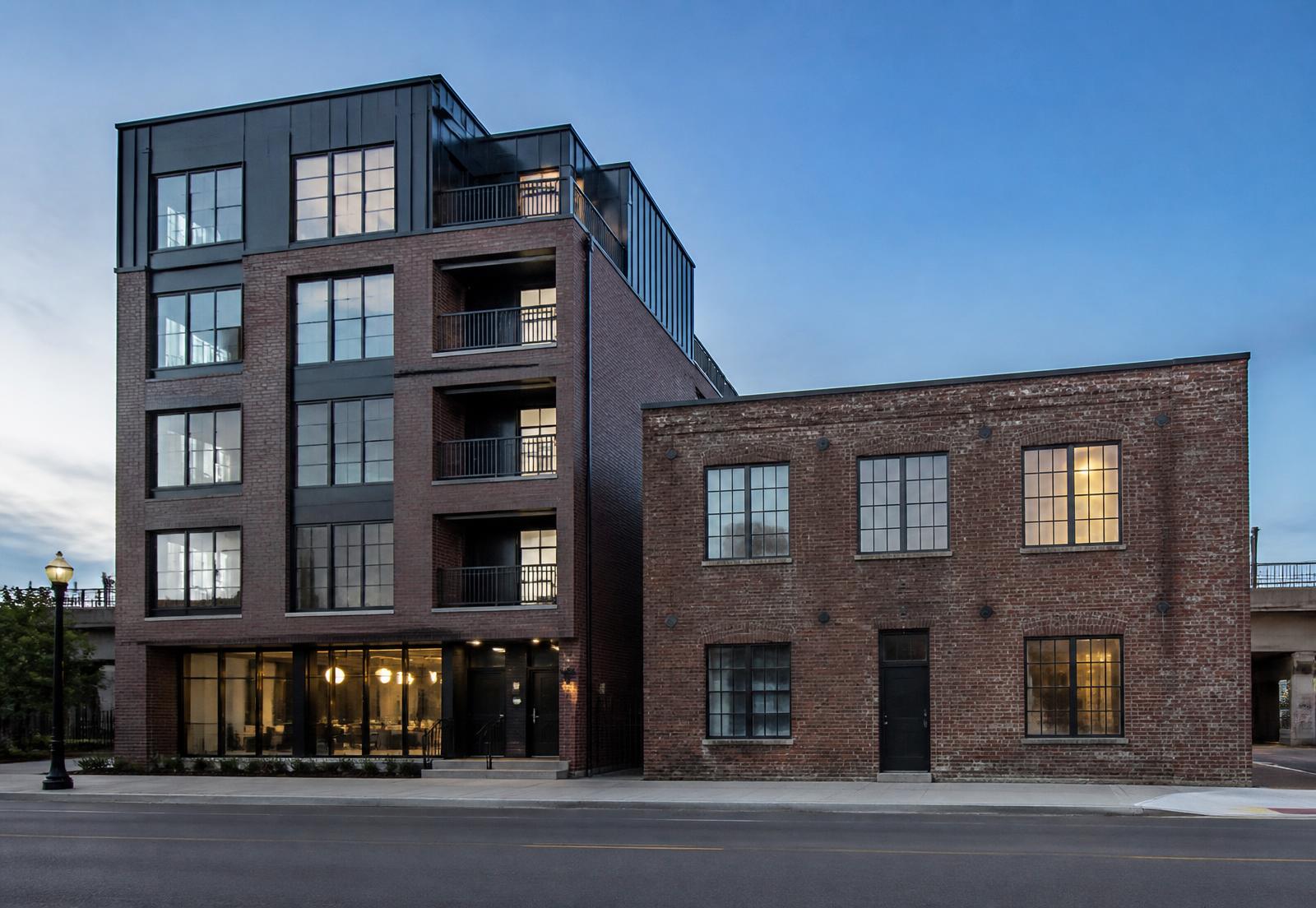
Mix of historic brick buildings and new mid-rise residential construction in NoDa

Real estate

NoDa Buildings & Communities

The district's residential inventory by building type — what each one is, when it was built, and who it suits.

NoDa's residential stock falls into four generations that sit within blocks of each other: mill-era village housing, the mill conversions, the 2000s infill condo and townhome wave, and the post-2018 transit-oriented apartment blocks.

This page covers the building-level picture — the communities themselves rather than individual units. We do not publish listings; for what any specific parcel contains, the county record is the authority.

Adaptive-reuse mill buildings

The oldest and most distinctive inventory, concentrated around the two mill complexes. These carry the highest character premium and the most complex.

They also carry the district's identity. When people say they want to live in NoDa specifically, this is usually the picture in their head.

Mill conversions

  • Highland Park Mill No. 3

    1903 cotton mill, converted to residential. The district's anchor building.

  • Mecklenburg Mill

    Adjacent complex mixing residential units with creative and studio space.

  • Johnston Mill Lofts

    Heavy-timber loft conversion with the most authentic industrial floor plans.

Condo and townhome communities

The 2000s and 2010s brought infill ownership product to underused parcels — mid-size condo buildings and rows of three-story townhomes, usually with attached parking and modern systems.

These are the district's low-surprise option. They trade less on character and more on convenience, and their pricing tracks new supply in the broader corridor more closely than the historic stock does.

Ownership product

  • Infill townhome rows

    Three-story attached homes, typically 2010s–2020s, with garage parking — the most common ownership product added since the Blue Line.

  • Boutique condo buildings

    Smaller-door-count buildings, often four to six stories, concentrated near the station corridor.

  • Live-work units

    Ground-floor commercial with residence above, scattered along the North Davidson spine.

Transit-oriented apartment communities

The largest volume of new doors since 2018 arrived as purpose-built rental near the 36th Street and 25th Street stations: four- and five-story blocks with structured parking, amenity decks, and ground-floor retail.

They are the reason the district's population grew quickly, and the reason its parking and traffic conversations intensified at the same time.

Mill-village houses

Not a community in the managed sense, but the largest single category of housing: detached cottages and bungalows on small lots, most of them a century.

This is where the district's owner-occupier core lives, and where renovation activity concentrates.

Why building type predicts resale more than square footage

In most Charlotte neighborhoods, price per square foot is a reasonable first approximation of value. In NoDa it is misleading, because the district contains at least five distinct product types whose buyer pools barely overlap. A mill loft, a 1910 cottage, a 2020 townhome and a corridor apartment conversion can sit within three blocks of each other and behave like separate markets.

Scarcity is the reason. Converted mill inventory is fixed and cannot be expanded, so it competes only with itself. New townhome and apartment product competes with everything being delivered along the corridor, which means its pricing is disciplined by supply in a way historic stock is not.

Understanding which market a building belongs to tells you which comparable sales are actually relevant, how long a sale is likely to take, and how much the property's value depends on district conditions versus on the building itself.

How to research a specific NoDa building before touring

Start with the county parcel record for construction year, ownership history and assessed history, then read the permit record for major capital work. A building that repointed its masonry or replaced a roof in the recent past has a different near-term cost profile than one that has deferred both.

Next, establish the building's governance. Is it a condominium with an association, a rental community under single ownership, or a set of individually owned townhomes with a small maintenance agreement? Governance determines who pays for what, how quickly problems get fixed, and how a lender will treat the property.

Finally, look at the building in the context of its pocket. Two similar buildings — one inside the historic core, one on the northern redevelopment frontier — face different rates of change around them, and that context is part of what you are underwriting.

Answers

Questions & Answers

What are the main residential buildings in NoDa?
The mill conversions — Highland Park Mill No. 3, Mecklenburg Mill, and Johnston Mill Lofts — anchor the district, alongside infill condo and townhome communities and post-2018 apartment blocks near the light rail stations.

Source: National Register of Historic Places — NC State Historic Preservation Office

Are there high-rises in NoDa?
No. Development in the district runs to four and five stories near the transit corridor, with lower heights through the historic mill village. Charlotte's Unified Development Ordinance governs the applicable limits parcel by parcel.

Source: City of Charlotte Unified Development Ordinance (2023)

Do NoDa buildings have parking?
Newer condo, townhome, and apartment communities generally include structured or garage parking. Mill conversions and older cottages often do not, and off-street parking is meaningfully capitalized into value in those cases.

Source: National Register of Historic Places — NC State Historic Preservation Office

How do I find out who owns a building in NoDa?
Ownership, parcel dimensions, assessed value, and recorded transfers are public through Mecklenburg County's POLARIS parcel viewer and the Assessor's.

Source: Mecklenburg County POLARIS 3G parcel viewer

How do I find out when a NoDa building was converted?
The county parcel record shows the original construction year, while the permit history usually reveals the conversion work itself. For listed mill complexes, National Register documentation often describes the original structure and its industrial use in detail.

Source: City of Charlotte / Mecklenburg County Code Enforcement permitting

Do NoDa apartment buildings and condos hold value differently?
They behave differently. Condominium and historic loft inventory is finite and competes mainly with itself, while rental-corridor product is exposed to whatever new supply is delivered nearby. That difference tends to show up in liquidity as much as in price.

Source: Canopy Realtor® Association market data

Recommendations

Who we recommend in NoDa

Four specialists we point people toward when a NoDa project moves from reading to doing. Each works this neighborhood specifically, not the metro generally.

Builder & renovation

Peters Custom Homes

New construction, mill-village restorations, and additions built to survive a historic district's constraints — from foundation work on 1910 cottages to infill on tight 28205 lots.

Real estate

Peters & Associates

Representation for buyers and sellers across NoDa's lofts, bungalows, and condo communities, with the market read that comes from working one neighborhood closely.

Interior design

Emerald & Oak

Interiors for brick-and-timber lofts and small-footprint bungalows: material palettes, custom millwork, lighting, and furnishing plans that respect the building.

Smart home & AV

Peters Audio Video

Networking, whole-home audio, theater, lighting control, and shading — engineered for masonry walls and open loft volumes where signal and acoustics fight back.