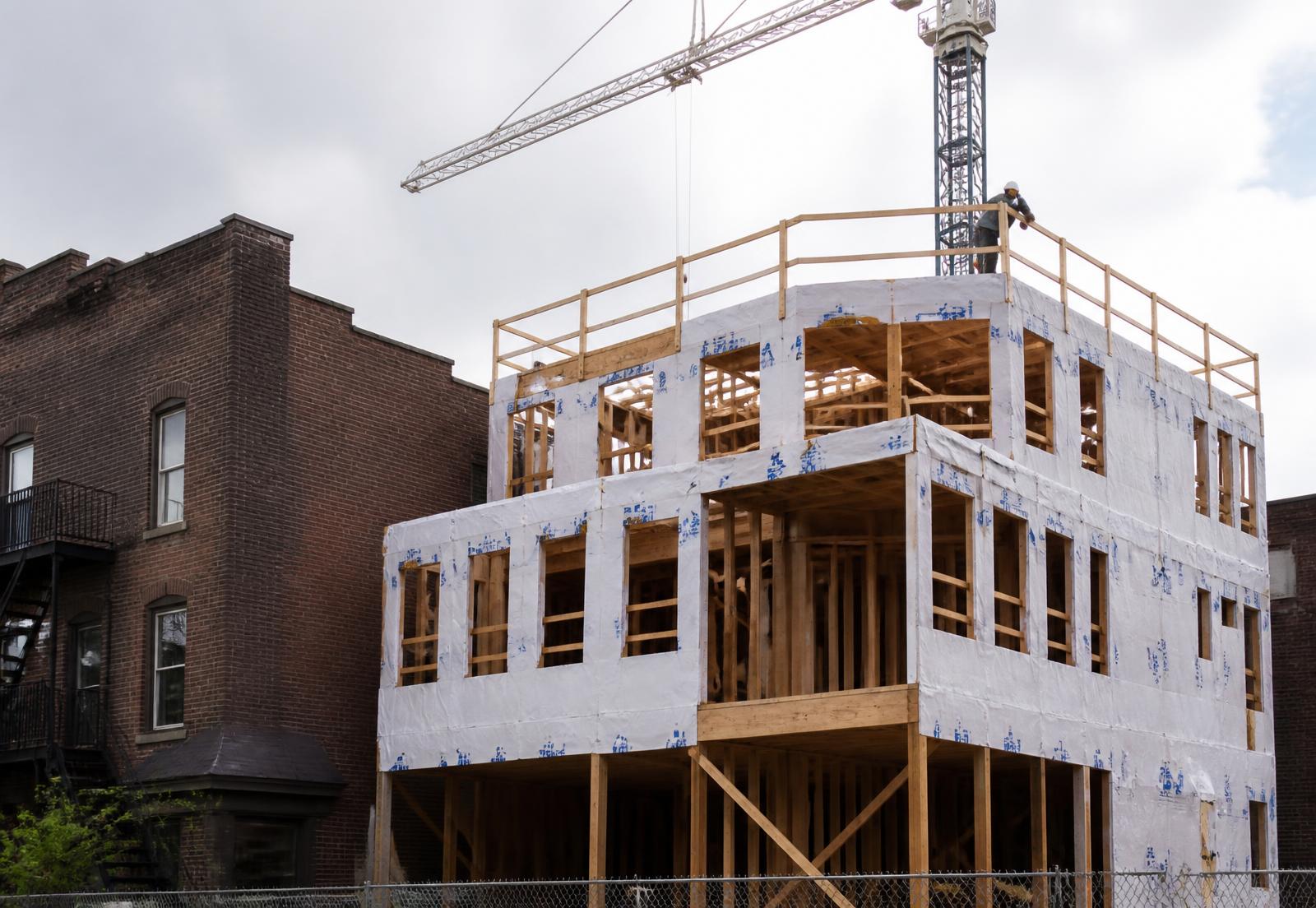
New residential construction framing next to historic brick buildings in NoDa

Building

New Construction in NoDa

Small lots, a 2023 ordinance, a transit corridor, and a historic village — four forces deciding what gets built here.

Building new in NoDa is a constrained exercise. Lots are small, neighbors are close, and the ordinance treats a parcel near the station very differently from one four blocks into the mill village.

The upside is that finished product performs. Buyers pay for modern systems in this location, and the supply of buildable land is genuinely limited, which supports pricing on well-executed infill.

What the ordinance allows

Charlotte's Unified Development Ordinance, effective 2023, replaced the previous zoning framework and introduced place-based districts. NoDa contains a mix, with transit-oriented designations near the stations permitting substantially more height and density than the neighborhood districts covering the village.

Because designations change within a few hundred feet, the only reliable approach is to check the specific parcel rather than the neighborhood. The county parcel viewer shows the designation; the ordinance text explains what it permits.

Historic overlays and design review

Where a parcel falls within a locally designated historic area, exterior work visible from the street requires review before permitting. That governs massing, materials, and fenestration in ways that can materially change a design.

National Register listing, by contrast, does not restrict private alterations by itself but does open rehabilitation tax credit eligibility. The two are frequently confused and have opposite practical effects.

Site realities on a mill-village lot

Access, staging, and tree protection dominate the practical side. A 4,000-square-foot lot with a house on either side leaves little room for material storage or equipment, which affects both schedule and cost.

Utilities are old in parts of the district, and service upgrades are a common line item that surprises first-time builders here.

Designing something that belongs

The infill that ages best in NoDa borrows proportion rather than pastiche: porch depth, roof pitch, window rhythm, and a scale that acknowledges its neighbors. The infill that ages worst maximizes square footage and ignores the street.

This is not only aesthetic. In a district where buyers are explicitly paying for character, a house that reads as an intrusion carries a resale penalty.

How infill design succeeds or fails on a mill-village lot

NoDa's original lots are narrow and shallow, and the houses on them are small, close to the street, and consistent in rhythm. Infill that ignores that rhythm reads as an intrusion no matter how well it is detailed, while infill that respects massing, setback and roof pitch can be entirely contemporary and still belong.

The failure mode is usually scale rather than style. A building that exceeds its neighbors' height and width by enough to break the street wall will look wrong for decades. Matching the pattern does not require imitation brick or fake historical detail — pastiche tends to age worse than honest modern work.

Practically, this means the site analysis matters more than the elevation. Understand the block's existing rhythm first, then design within it.

What to verify before buying a new-construction NoDa home

New construction removes the maintenance uncertainty of a century-old house and replaces it with a different set of questions. Confirm who built it and what warranty applies, review the permit record for the actual work performed, and look carefully at site conditions, because narrow infill lots create drainage and grading problems that only appear after a heavy rain.

Ask about what is planned next door. Infill happens in clusters, and buying the first completed home on a block often means living beside construction.

Finally, check how the home is oriented relative to the strip and the corridor. Builders sometimes maximize buildable area at the expense of livability, and a new home with excellent finishes facing an active parking area is still a home facing an active parking area.

Verification checklist for infill purchases

  • Builder and warranty

    Who stands behind the work, and for how long, in writing.

  • Permit record

    Confirm the finished house matches what was approved.

  • Site drainage

    Narrow lots concentrate water. Look at grading and downspout discharge.

  • Neighboring parcels

    Zoning on adjacent lots determines what can appear next to you later.

  • Orientation

    What the primary living spaces face is permanent in a way finishes are not.

Answers

Questions & Answers

Can you build new homes in NoDa?
Yes, on infill parcels. What is permitted depends on the parcel's designation under Charlotte's Unified Development Ordinance, which varies significantly between transit-oriented areas near the stations and neighborhood districts in the mill village.

Source: City of Charlotte / Mecklenburg County Code Enforcement permitting

What is the zoning in NoDa?
NoDa contains a mix of designations under the 2023 Unified Development Ordinance, including transit-oriented districts near the light rail stations and lower-intensity neighborhood districts through the historic village. Verify the specific parcel rather than assuming a district-wide answer.

Source: City of Charlotte Unified Development Ordinance (2023)

Does a historic designation stop me from building in NoDa?
Local historic designation subjects street-visible exterior work to design review before permitting. National Register listing alone does not restrict private alterations but can make rehabilitation tax credits available.

Source: City of Charlotte / Mecklenburg County Code Enforcement permitting

What permits do I need to build in NoDa?
Building, electrical, mechanical, and plumbing permits are issued through Mecklenburg County Code Enforcement, with zoning clearance from the City of Charlotte and, where applicable, historic design review preceding them.

Source: City of Charlotte / Mecklenburg County Code Enforcement permitting

Do I need a licensed contractor?
North Carolina requires a licensed general contractor for projects above the statutory cost threshold. License status is verifiable through the NC Licensing Board for General Contractors.

Source: NC Licensing Board for General Contractors

Is new construction allowed in NoDa's historic areas?
Yes, subject to zoning under the UDO and, where a local historic overlay applies, design review of what is visible from the street. Contemporary architecture is generally acceptable when massing, setback and scale respect the existing block pattern.

Source: City of Charlotte Unified Development Ordinance (2023)

Does new construction in NoDa hold value as well as historic housing?
Historic stock benefits from fixed supply, while new construction competes with subsequent deliveries nearby. Well-sited infill on a strong residential block performs closer to historic housing than generic product on a redevelopment corridor does.

Source: City of Charlotte Unified Development Ordinance (2023)

Recommendations

Who we recommend in NoDa

Four specialists we point people toward when a NoDa project moves from reading to doing. Each works this neighborhood specifically, not the metro generally.

Builder & renovation

Peters Custom Homes

New construction, mill-village restorations, and additions built to survive a historic district's constraints — from foundation work on 1910 cottages to infill on tight 28205 lots.

Real estate

Peters & Associates

Representation for buyers and sellers across NoDa's lofts, bungalows, and condo communities, with the market read that comes from working one neighborhood closely.

Interior design

Emerald & Oak

Interiors for brick-and-timber lofts and small-footprint bungalows: material palettes, custom millwork, lighting, and furnishing plans that respect the building.

Smart home & AV

Peters Audio Video

Networking, whole-home audio, theater, lighting control, and shading — engineered for masonry walls and open loft volumes where signal and acoustics fight back.

Primary sources

What this page is built on

We cite the primary record rather than aggregator estimates. Where a figure moves, check the source directly before relying on it.

  1. 01City of Charlotte Unified Development Ordinance (2023)
  2. 02City of Charlotte / Mecklenburg County Code Enforcement permitting
  3. 03NC Licensing Board for General Contractors
  4. 04Charlotte-Mecklenburg Historic Landmarks Commission
  5. 05Mecklenburg County POLARIS 3G parcel viewer