Journal · November 19, 2026
Designing a NoDa Mill Loft for Everyday Life
A useful mill-loft interior starts with the building’s constraints, then makes room for privacy, comfort, storage, and ordinary daily routines.
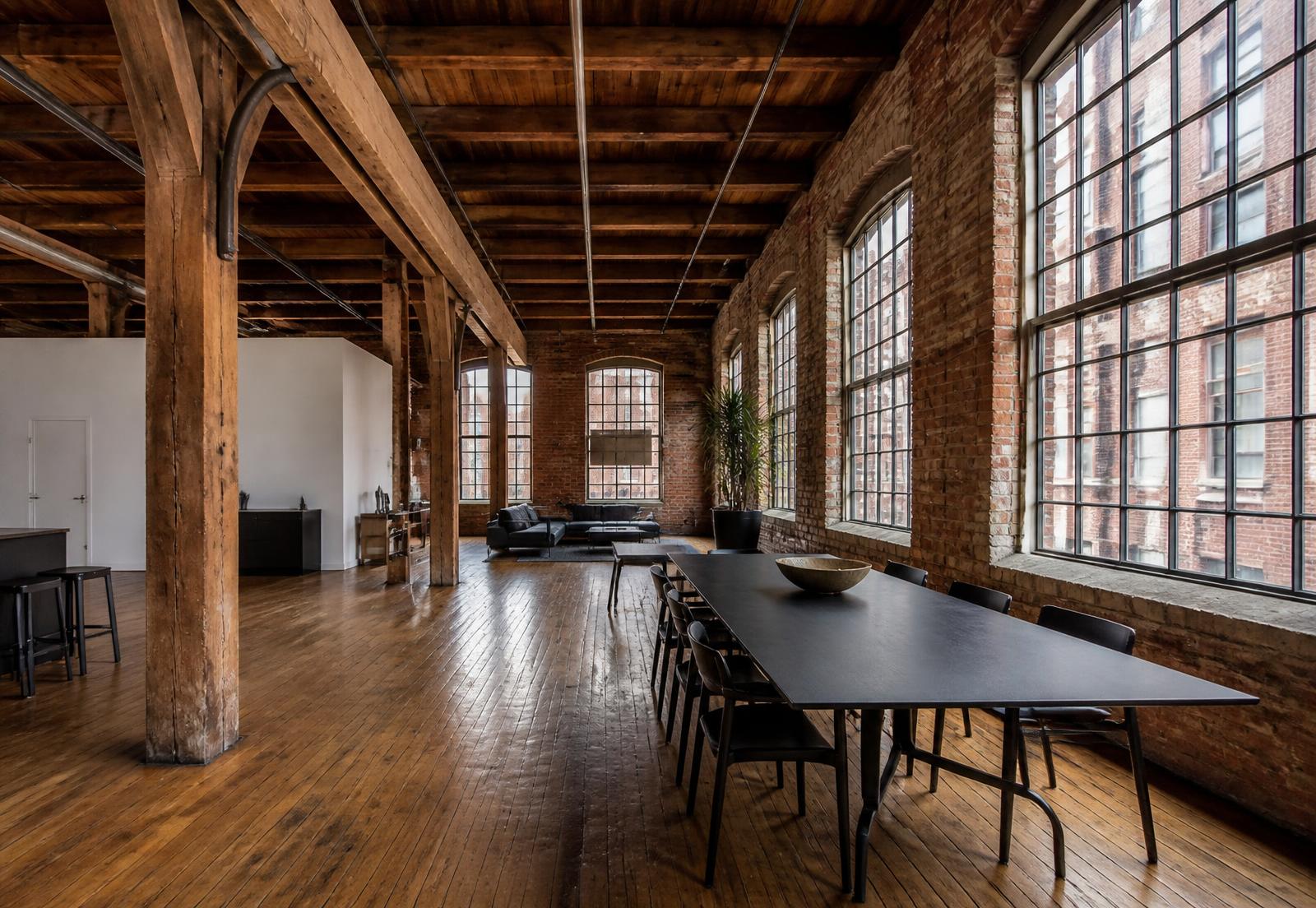
A mill loft can offer a compelling starting point for an interior: substantial volume, an irregular structural rhythm, and surfaces that do not need decoration to hold attention. But those qualities do not automatically produce a comfortable home. An open room still needs somewhere to put coats, take a private call, sleep away from glare, and eat without clearing a work desk. In NoDa, the strongest design approach is not to reproduce an industrial look. It is to understand the particular building, then make its space usable.
The textile history associated with North Davidson provides context, not a universal specification. A converted mill, a later addition, and a newer apartment marketed with loft language may have very different construction and alteration rules. Our history of NoDa and the mill village supplies background; decisions about an interior require documents and measurements for the actual space.
Start with what the building will allow
Before choosing finishes, establish whether the home is a rental or an individually owned unit, and obtain the applicable lease, alteration policy, or condominium documents. Ask who controls windows, exterior walls, structural elements, and shared mechanical systems. Ownership of a unit does not necessarily mean authority to change everything visible inside it. The distinction matters especially when a design depends on drilling masonry, moving plumbing, or attaching something to an overhead structure.
Use Mecklenburg County POLARIS to locate the parcel and review the property information available there. Do not treat a parcel record as permission to renovate or proof of an interior feature’s age. For proposed work, ask the City of Charlotte which permitting or preservation reviews apply to that address and scope. Separately, request written approval from the owner or association where required. The guide to NoDa mill lofts and adaptive reuse is a starting point for understanding the building type, not a substitute for those approvals.
Draw the daily routine before buying furniture
Make a measured plan showing columns, doors, window openings, outlets, supply and return grilles, and fixed equipment. Record ceiling heights where they change, rather than assuming one measurement describes the entire room. Include door swings and the space needed to open drawers. An attractive furniture arrangement fails quickly if it blocks a return grille or forces someone to squeeze past a chair to reach the bathroom.
Then mark activities instead of conventional room names. Where will someone work while another person cooks? Where can a guest put a bag? What needs to disappear from view at the end of the day? In a large open volume, a sofa back, low cabinet, or rug can define an area without creating a wall. Use painter’s tape only on finishes that can tolerate it, or lay out paper templates to test furniture footprints.
- Protect circulation: keep routes to doors and required exits clear, and have a qualified professional confirm applicable clearance requirements.
- Test delivery: measure the access route, including elevators, stairs, turns, and door openings; ask management about delivery restrictions.
- Choose useful scale: compare seat depth, table reach, and storage capacity, not just whether a piece looks substantial beneath a high ceiling.
Separate echo from noise transmission
Hard surfaces can make conversation feel sharper inside a room. Rugs with suitable pads, upholstered seating, curtains, and fabric-covered furnishings can help absorb reflected sound. Spread those materials through the occupied areas rather than expecting one small rug to change an entire loft. Ask about floor-covering requirements before selecting a pad, particularly in a shared building.
Sound arriving through a party wall, floor, window, or ventilation path is a different problem. Decorative acoustic panels are not a reliable cure for transmission between homes. Ask management about the documented wall and floor assemblies and any restrictions on acoustic work. If quiet is essential for sleep or recording, seek an acoustic assessment before committing to a design that assumes soft furnishings will solve the issue. The condominium and townhome guide offers broader context for shared-building decisions.
Design for daylight and darkness
A tall window can illuminate a room beautifully while leaving a desk with glare and a sleeping area without privacy. Establish the window orientation and observe the space at different times when access permits. Check which panes open, where hardware projects, and whether a shade would interfere with ventilation or access. Do not assume an existing curtain rod establishes permission for additional anchors.
Layer lighting around tasks: reading beside a chair, preparing food, working at a desk, and moving through the home after dark. Portable lamps can make these zones legible without trying to light the entire ceiling volume. Confirm electrical capacity, fixture compatibility, and installation requirements with a qualified electrician before adding hardwired lighting or controls. For motorized shades or connected switches, the questions in our smart-home and AV guide belong early in planning, before hardware is ordered.
Let the fabric lead, without treating it as untouchable décor
If brick, timber, or older flooring is exposed, identify its condition and role before altering it. Avoid painting masonry, abrasive cleaning, or fastening into beams simply to achieve a reference image. Ask the owner or association what treatments are permitted, and have an appropriate professional evaluate proposed work. A surface can be visually interesting and still need investigation for moisture, deterioration, or earlier coatings.
A restrained material palette can keep the interior coherent without adding more brick effects, pipe shelving, or distressed finishes. Smooth cabinetry and washable textiles can provide useful contrast. Removable furnishings also make it easier to change the layout without repeatedly disturbing the building. Our NoDa architecture guide gives context for reading buildings; it cannot establish the significance or condition of an individual interior surface.
Make storage and maintenance part of the composition
Open plans expose ordinary clutter. Allocate closed storage for cleaning supplies, laundry, paperwork, luggage, and recycling before reserving every wall for art. Favor storage that can be reached safely and serviced without moving half the room. Do not use tall cabinetry to create an improvised sleeping enclosure: new partitions or enclosed areas can raise ventilation, sprinkler, and egress questions that need professional review.
Before finalizing an interior-design brief for NoDa Charlotte, assemble a measured plan, written approvals, a lighting scheme, and a list of unresolved technical questions. Neither a neighborhood label nor the ZIP code 28205 establishes a home’s construction, comfort, or permitted alterations. The interior-design guide for NoDa lofts and bungalows can help organize the choices. The goal is not a room that merely photographs as a loft, but a home whose distinctive structure supports everyday life.
How this entry was made: journal entries are drafted with an AI writing model and published automatically only after passing editorial checks for length, sourcing language, internal links and banned unverified claims. They contain no first-hand visits, interviews or quotes. Read our methodology and disclosures, or report an error to npeters@yourleaderinluxury.com.
Answers
Questions & Answers
Can I paint exposed brick in a NoDa mill loft?
Will rugs and curtains soundproof a mill loft?
What should I verify before ordering loft furniture?
More from the journal
Home Technology in NoDa: Start With the Building
In NoDa homes, useful technology starts with the room, the building rules, and a clear plan for what should work when the internet does not.
Making Room in NoDa: A Brief for Custom Homes and Renovations
A useful NoDa building brief starts with the existing house, the limits of the lot, and the everyday life the finished project needs to support.
Investing in NoDa Without Betting on the Neighborhood Name
NoDa’s identity can explain an investment thesis, but rental permissions, building obligations, and conservative cash flow must carry the decision.
Publisher's businesses
The Peters businesses
Reading only gets a NoDa project so far. When it turns into offers, drawings or wiring, these are the companies connected to this guide.
These businesses are owned by or connected to this guide's publishers, Nicholas and Miriam Peters. Read the disclosure.
The wider family of guides is on Beyond NoDa.
- 01
Luxury real estate
Peters & Associates
The Peters brokerage's luxury practice, led by Nicholas and Miriam Peters, representing buyers and sellers privately.
Buying or selling a higher-end NoDa home — a renovated bungalow, a new infill house, a top-floor loft.
- 02
Real estate representation
Peters & Associates — The Peters Team
The same brokerage's Charlotte-wide site, with a home search and home-valuation requests. A separate website from yourleaderinluxury.com, not a redirect.
Condos, townhomes and first purchases, or weighing NoDa against other Charlotte neighborhoods.
- 03
Luxury custom home builder
Peters Custom Homes
A founder-led Charlotte builder of a small number of custom estate homes a year.
A substantial new house or major rebuild on a lot that can support one. Most NoDa lofts and condos are not that project.
- 04
Luxury spec home builder
Peters Signature Homes
The Peters spec-home company, building finished homes for sale rather than to a client's drawings.
Buyers who want a newly built house without running a build. No current NoDa inventory is implied.
- 05
Interior design
Emerald & Oak Design
Miriam Peters' interior design studio, working on custom homes, renovations and new construction.
Planning a renovation or furnishing a loft or bungalow where layout and materials both matter.
- 06
Home audio, video & technology
Peters Audio Video
Home theatres, whole-home audio, lighting control, networking and security.
Wiring a renovation or new build. In a condo, check building rules on penetrations and wiring first.
- 07
Luxury travel guides
Peters Signature Travel
Luxury travel guides, hotel reviews and destination insights.
Not a NoDa service — listed so it stays one click away.