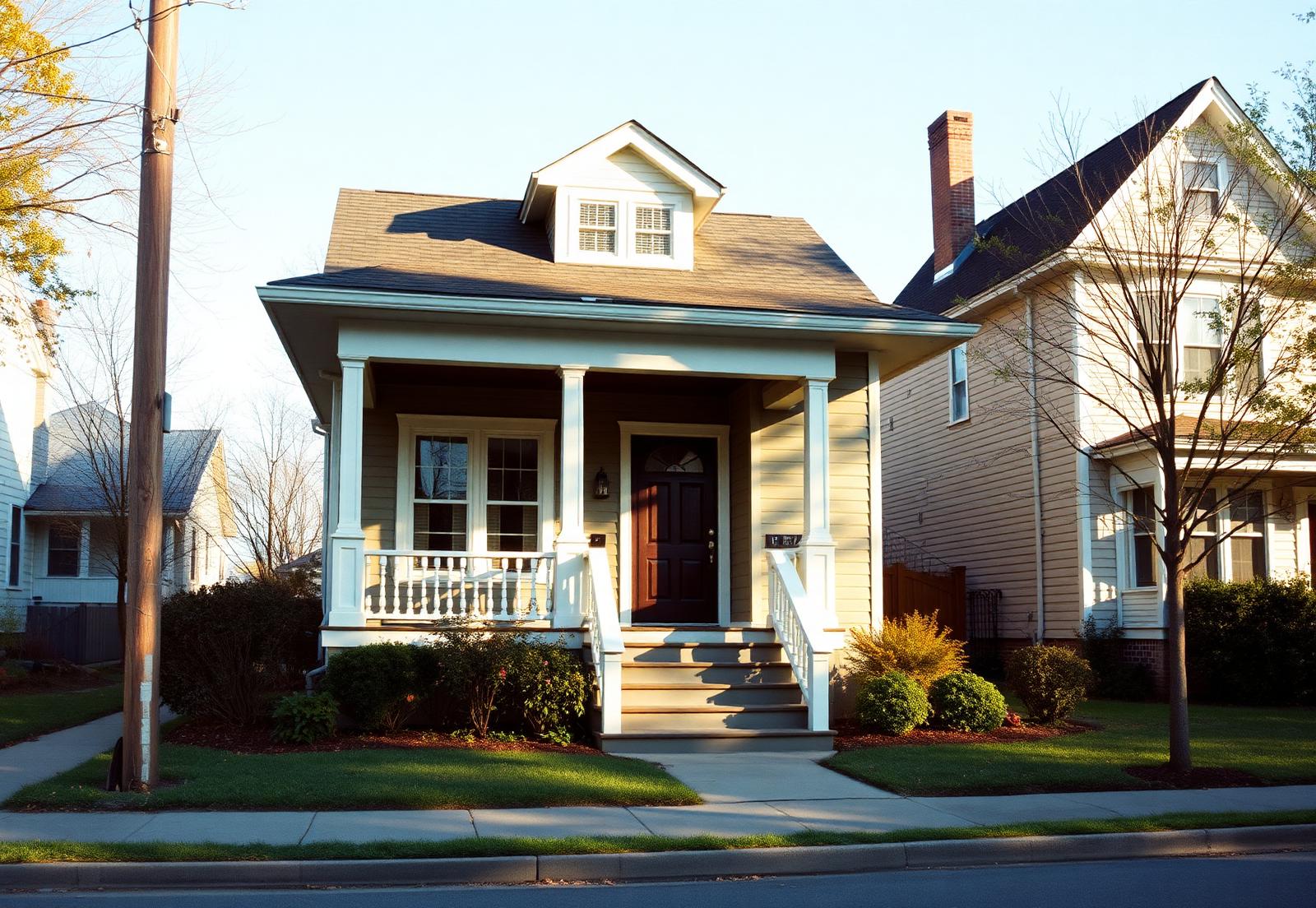
Restored craftsman bungalow with a deep front porch next to a newer infill house on a Charlotte mill-village street

Market

NoDa Home Values

Why automated estimates struggle in 28205, and how to read value in a neighborhood with no two identical houses.

NoDa is one of the harder Charlotte neighborhoods to value automatically, and the reason is structural. The housing stock mixes 1910s mill cottages, restored bungalows, 1990s infill, converted mill lofts, condo-form townhomes and brand-new construction — sometimes on the same block.

Automated valuation models depend on nearby, recent, similar sales. NoDa reliably supplies nearby and recent. It rarely supplies similar. That gap is where most valuation error in this ZIP code comes from.

This page explains what actually drives value here and how to test any number you are given, whether it came from an algorithm, an appraiser, or a listing agent.

What actually drives value in NoDa

Rank order matters more than any single factor. In this district, location within the district comes first — specifically, walking distance to the North Davidson corridor and to 36th Street Station. Two otherwise identical houses six blocks apart do not trade at the same number.

Second is the lot: its size, its width, whether it can support an addition or an accessory structure, and what the zoning permits. In a neighborhood where structures get replaced and expanded, land carries value that improvements do not.

Third is the structure itself — original character where it survives, systems age, and the quality of any renovation. Finish level matters, but it is a smaller lever here than in a subdivision where the lots are interchangeable.

Why automated estimates miss

An automated model needs comparable sales to calibrate. When the three nearest sales are a mill loft, a new townhome and an unrenovated 1920s cottage, the model averages across product types that buyers treat as completely different goods.

Renovation depth is also invisible to most models. Two bungalows of identical square footage — one with original systems and one taken to the studs with new mechanicals, a rebuilt foundation and a reworked floor plan — can differ enormously in market value while looking identical in tax records.

Treat any automated estimate in 28205 as a very wide range, not a number. Use it to sanity-check direction, never to set a list price or an offer.

How to read comps properly here

Start by matching product type before you match anything else. A loft comps to lofts, a townhome to townhomes, a bungalow to bungalows. Cross-type comps require adjustments large enough that they stop being reliable.

Then match walkability. Distance to the corridor and the rail station is the strongest intra-neighborhood variable, and it does not appear in most comp reports. Draw it on a map yourself.

Then match condition honestly. Look at listing photos, permit history and the renovation scope, not just the year built. A permit search will often tell you more about a house's real condition than the marketing description does.

Finally, weight recency. In a market that moves, a six-month-old sale in a mixed-stock neighborhood is a weaker signal than a fresh one, even if the property matched better.

Tax value versus market value

Mecklenburg County's assessed value is a mass-appraisal figure produced on a revaluation cycle. It is not a market appraisal, it is not current between cycles, and it is not intended to be either.

Assessed values are still useful for two things: comparing relative assessment across similar properties, and understanding your carrying cost. For pricing decisions, they are a data point, not an answer.

If you believe an assessment is materially wrong on the facts — wrong square footage, wrong condition, wrong lot data — the county appeal process exists for that. Fix the record before arguing about the number.

What renovations actually return in NoDa

The pattern here favors work that fixes structural or systems risk and work that adds usable space, over work that upgrades finishes already considered acceptable.

Buyers in this neighborhood price uncertainty aggressively. A documented roof, updated electrical, a dry crawl space or basement, and a modern HVAC remove discount pressure. Cosmetic upgrades on top of unresolved systems do not.

Adding functional square footage — a rear addition, a finished attic that meets code, or a permitted accessory structure where zoning allows — tends to return well, because supply of larger homes inside the walkable radius is genuinely constrained. Verify what the zoning permits before assuming any of it is possible.

Testing a valuation before you rely on it

Run the same three questions on any number you receive. First: which specific sales support it, and are they the same product type? Second: how far is each comp from the corridor and the station relative to the subject? Third: what condition adjustments were applied, and are they documented or assumed?

If a valuation cannot answer those three questions, it is not a valuation — it is an opinion with a decimal point. That applies equally to algorithms and to people.

Answers

Questions & Answers

How much are homes worth in NoDa?
There is no single figure, because the stock ranges from 1910s mill cottages to new construction. Value is set primarily by walk distance to the North Davidson corridor and 36th Street Station, then by lot, then by condition and product type.

Source: National Register of Historic Places — NC State Historic Preservation Office

Why are online home value estimates wrong in NoDa?
Automated models need similar nearby sales. NoDa's blocks mix lofts, townhomes, bungalows and new builds, so the models average across product types buyers treat as entirely different, and they cannot see renovation depth.

Source: CEDIA — integrated home technology standards

What ZIP code is NoDa in?
NoDa's core is in 28205, with portions along its western and southern edges falling into 28206.

Source: City of Charlotte

Is tax assessed value the same as market value in NoDa?
No. The Mecklenburg County assessed value is a mass-appraisal figure produced on a revaluation cycle and is not a current market appraisal.

Source: Mecklenburg County Assessor's Office property records

Which renovations add the most value in NoDa?
Work that removes risk — roof, electrical, HVAC, moisture — and work that adds permitted usable square footage. Finish upgrades on top of unresolved systems return the least.

Source: City of Charlotte / Mecklenburg County Code Enforcement permitting

Recommendations

Who we recommend in NoDa

Four specialists we point people toward when a NoDa project moves from reading to doing. Each works this neighborhood specifically, not the metro generally.

Builder & renovation

Peters Custom Homes

New construction, mill-village restorations, and additions built to survive a historic district's constraints — from foundation work on 1910 cottages to infill on tight 28205 lots.

Real estate

Peters & Associates

Representation for buyers and sellers across NoDa's lofts, bungalows, and condo communities, with the market read that comes from working one neighborhood closely.

Interior design

Emerald & Oak

Interiors for brick-and-timber lofts and small-footprint bungalows: material palettes, custom millwork, lighting, and furnishing plans that respect the building.

Smart home & AV

Peters Audio Video

Networking, whole-home audio, theater, lighting control, and shading — engineered for masonry walls and open loft volumes where signal and acoustics fight back.

Primary sources

What this page is built on

We cite the primary record rather than aggregator estimates. Where a figure moves, check the source directly before relying on it.

  1. 01Mecklenburg County Assessor's Office property records
  2. 02Mecklenburg County POLARIS 3G parcel viewer
  3. 03NC Department of Revenue — individual income tax
  4. 04Canopy Realtor® Association market data
  5. 05City of Charlotte / Mecklenburg County Code Enforcement permitting