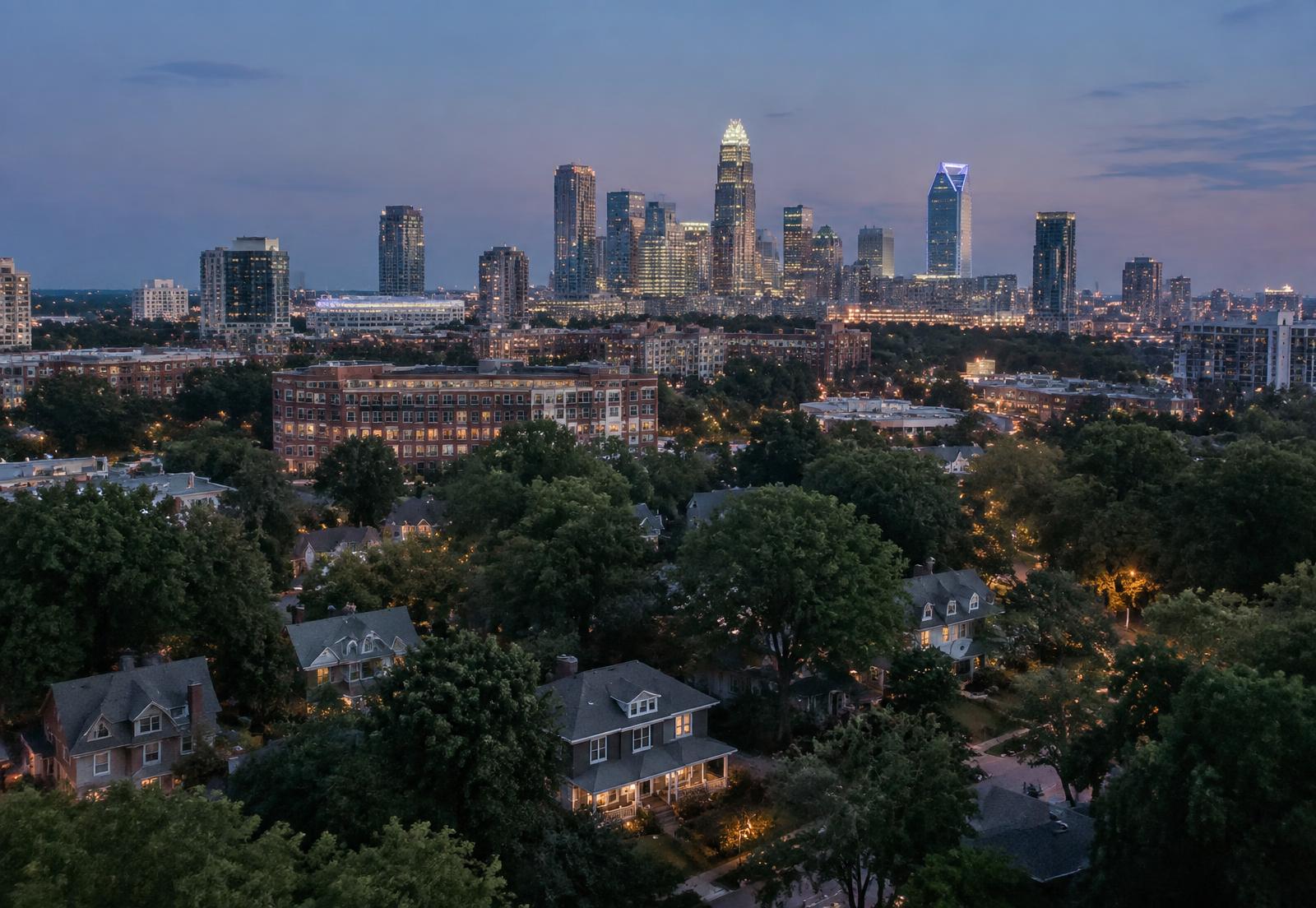
Elevated dusk view across tree-lined Charlotte residential streets with mid-rise brick buildings and the downtown skyline beyond

City context

The Best Neighborhoods in Charlotte, NC

There is no single best neighborhood — there is the one that matches how you want to live. Here is how Charlotte's best-known districts actually differ.

Every list of Charlotte's best neighborhoods is really a list of preferences wearing a ranking's clothes. A district that is perfect for someone who wants to walk to live music is the wrong answer for someone who wants a yard and a two-car garage.

We publish this comparison because we write about one of these neighborhoods in depth, and the honest thing to do is show where it fits rather than claim it wins. What follows is a comparison by characteristic, not a leaderboard.

Start with how you want to live, not with a ranking

Four questions separate Charlotte neighborhoods faster than any list: do you want to walk to dinner or drive to it; do you want a yard; do you want old construction with character and maintenance, or newer construction with fewer surprises; and does rail access matter to your commute.

Answer those four and most of the city sorts itself. The districts below are grouped by the kind of answer they suit rather than ordered best to worst.

NoDa — historic fabric, arts culture, rail access

NoDa is a former textile mill village northeast of Uptown, now an arts district. The housing is early-twentieth-century mill cottages, converted mill lofts, and newer infill townhomes and apartments, all within a compact walkable core served by two Blue Line stations.

It suits people who want genuine old building stock, a dense cluster of galleries, music venues, breweries and restaurants within walking distance, and the option of leaving the car parked. The trade-offs are real: small lots, contested street parking, and hundred-year-old construction that hides expensive problems.

Because we cover NoDa page by page, the detailed version of everything above lives across this site rather than in a paragraph.

Plaza Midwood — older Charlotte with more yard

Plaza Midwood sits southeast of NoDa and shares a similar era of construction, but with a higher share of single-family houses on larger lots and a retail personality that runs more toward restaurants and long-standing independent businesses than galleries.

It suits someone who wants walkable older Charlotte but with more house and more ground than a mill village provides. The trade-off is that rail access is not part of the picture the way it is along the Blue Line corridor.

South End — new construction, density, the rail spine

South End runs southwest from Uptown along the same light rail line. It is the most rebuilt district on this list: mostly recent mid-rise apartments and condos, a wide commercial corridor, and a rail trail that functions as its main street.

It suits people who want new construction, amenity buildings, and the shortest possible list of maintenance surprises. The trade-off is character — very little of what stands there is old, and the district reads as newly built because it is.

Uptown — the center city

Uptown is Charlotte's central business district: towers, offices, arenas, structured parking, and high-rise residential above it. It suits people who want to live inside the business core and walk to work, and who do not need a porch or a yard to feel at home.

The trade-off is everything a neighborhood grid provides — street-level continuity, front doors, and the kind of evening activity that comes from people living at low rise rather than high.

Dilworth, Myers Park and the older southern districts

South of Uptown, Dilworth and Myers Park represent Charlotte's established residential tradition: mature tree canopy, larger houses, deep lots and long-standing school reputations. They suit buyers prioritizing space, canopy and stability over walkable nightlife.

The trade-off is price per square foot and a lifestyle that assumes a car for most daily errands, even where sidewalks are excellent.

How to use a comparison like this

Neighborhood labels in Charlotte are conventional, not legal. School assignment, zoning and tax treatment follow the parcel, not the name of the district it sits in, and two houses four blocks apart can differ on all three. Verify at the parcel level before a label influences a decision.

Rankings also age badly. Construction, transit extensions and commercial turnover all move faster than the articles describing them. Use a comparison to shortlist, then spend an evening standing on the street at the hour you would actually be living there.

Answers

Questions & Answers

What is the best neighborhood in Charlotte, NC?
There is no single best — the right answer depends on whether you want walkable old fabric, new construction, a large yard or a downtown tower. NoDa, Plaza Midwood, South End, Uptown and Dilworth each suit a different set of priorities.

Source: HUD — fair housing and rental assistance resources

Which Charlotte neighborhood is the most walkable?
NoDa, South End and Uptown are the most car-optional of the well-known districts, all three sitting on or beside the LYNX Blue Line with daily destinations within walking distance.

Source: Charlotte Area Transit System — LYNX Blue Line

Is NoDa or South End better?
NoDa is historic mill-village fabric with an arts identity; South End is largely new mid-rise construction along the rail trail. Choose NoDa for character and old building stock, South End for new construction and building amenities.

Source: National Register of Historic Places — NC State Historic Preservation Office

Which Charlotte neighborhood is best for families?
It depends on school assignment, which follows the parcel rather than the neighborhood name. Verify assignment for the specific address with the school district before treating any neighborhood as a family answer.

Source: Mecklenburg County POLARIS 3G parcel viewer

Which Charlotte neighborhoods have light rail?
The LYNX Blue Line runs from the university area through NoDa and Uptown into South End and south Charlotte, which is why those districts are the most transit-oriented in the city.

Source: Charlotte Area Transit System — LYNX Blue Line

Are Charlotte neighborhood boundaries official?
Mostly not. Names like NoDa, Plaza Midwood and South End are conventional rather than municipal, so anything with legal consequence should be checked against the parcel record.

Source: Mecklenburg County POLARIS 3G parcel viewer

In practice

The people we send readers to

Reading only gets a NoDa project so far. When it turns into drawings, offers or wiring, these are the practices we name — each works this neighborhood specifically.

Editorial recommendations — see how we choose

  1. 01

    Real estate

    Peters & Associates

    Buyer and seller representation across NoDa's mill lofts, bungalows and condo communities — the market read that comes from working one neighborhood closely rather than the whole metro thinly.

    Read the NoDa market desk at Peters & Associates (opens in a new tab) yourleaderinluxury.com

  2. 02

    Building & renovation

    Peters Custom Homes

    New construction, mill-village restorations and additions built for a historic district's constraints — foundation work under 1910 cottages, infill on tight 28205 lots, roofs that answer to the streetscape.

    Read how Peters Custom Homes approaches a historic-district build (opens in a new tab) peterscustomhomes.com

  3. 03

    Interior design

    Emerald & Oak

    Interiors for brick-and-timber volumes and small-footprint bungalows: material palettes, custom millwork, lighting plans and furnishing layouts that let the original building keep the last word.

    Read the loft interiors Emerald & Oak has drawn (opens in a new tab) emeraldoakdesign.com

  4. 04

    Smart home & AV

    Peters Audio Video

    Networking, whole-home audio, theatre, lighting control and shading engineered for masonry walls and open loft volumes, where signal and acoustics both fight back.

    Read the systems work Peters Audio Video does in old masonry (opens in a new tab) petersaudiovideo.com

  5. 05

    Charlotte-wide search

    Peters Team

    For readers weighing NoDa against Plaza Midwood, South End or the lake corridors, a broader Charlotte practice that can hold several neighborhoods in view at once.

    Read a wider Charlotte search with the Peters Team (opens in a new tab) petersteamrealty.com

Primary sources

What this page is built on

We cite the primary record rather than aggregator estimates. Where a figure moves, check the source directly before relying on it.

  1. 01City of Charlotte
  2. 02Charlotte Area Transit System — LYNX Blue Line
  3. 03Mecklenburg County POLARIS 3G parcel viewer
  4. 04Charlotte-Mecklenburg Schools school locator
  5. 05U.S. Census Bureau QuickFacts — Charlotte, NC