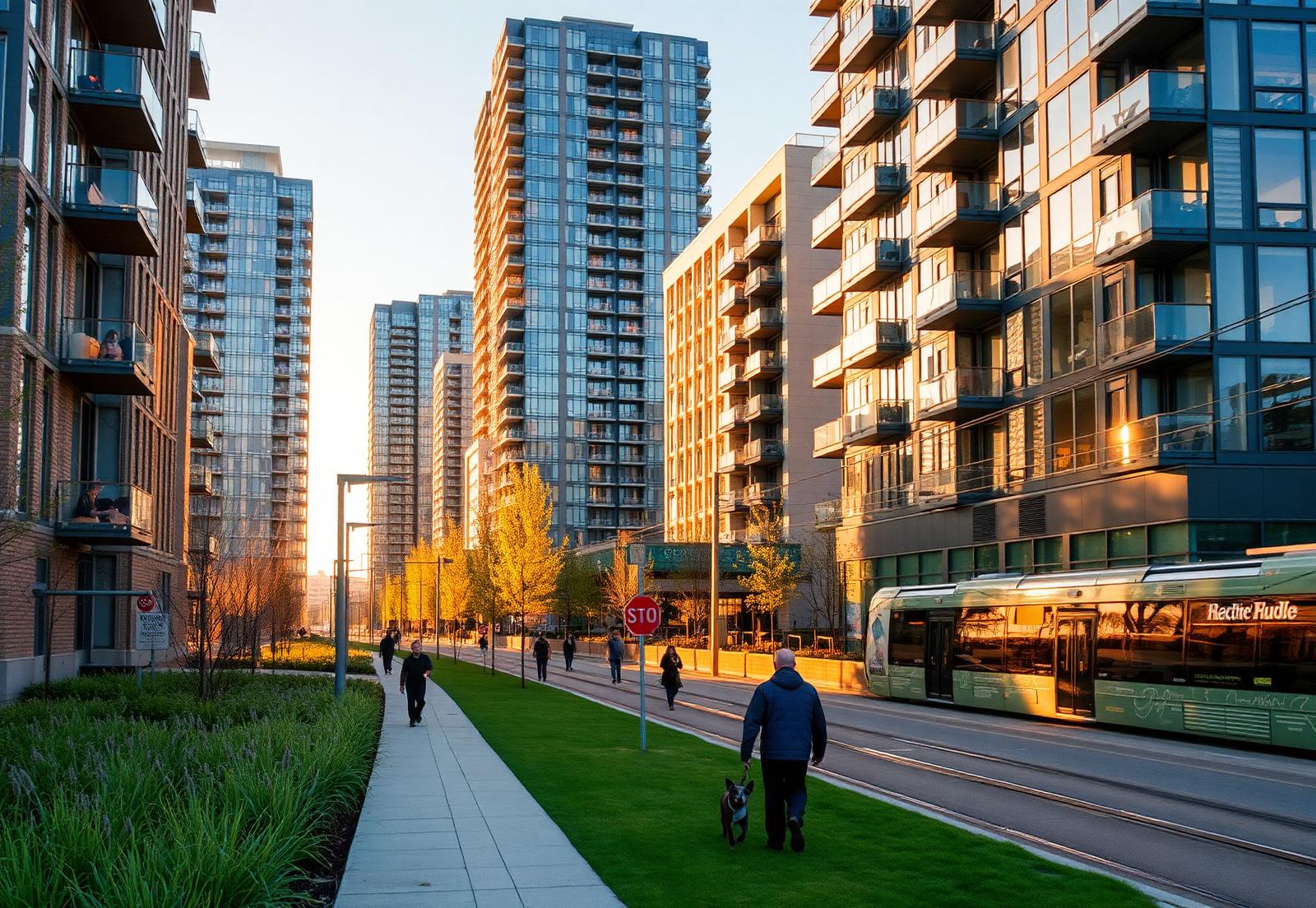
Modern mid-rise apartment buildings along a light-rail line at golden hour in Charlotte

Comparison

NoDa vs. South End

Same rail line, opposite development stories.

NoDa and South End sit on the same LYNX Blue Line, on opposite sides of Uptown, and they get compared constantly because both are walkable, transit-served and full of bars and restaurants.

What separates them is what got built. South End redeveloped fast and vertically over the last two decades. NoDa redeveloped slowly, around a surviving historic core it largely kept. That single difference cascades into almost everything else.

Building stock: kept versus rebuilt

NoDa's identity rests on buildings that survived. Mill structures were converted rather than demolished, the historic commercial storefronts along North Davidson still hold most of the retail, and the residential blocks are dominated by early-twentieth-century cottages with newer infill worked in between.

South End's identity rests on what replaced the industrial fabric. Its residential stock is overwhelmingly recent — mid-rise and high-rise apartments and condos, with new townhomes filling the gaps. Some warehouse conversions remain, but the dominant experience is new construction.

If you want exposed brick, timber and original scale, NoDa has substantially more of it. If you want current-generation building systems, elevators, structured parking and amenity floors, South End has substantially more of that.

Density and scale

South End reads as a small city: taller buildings, wider streets in places, structured parking decks, and a much larger resident population packed into the corridor. That density supports more retail, more gyms, more services and more rooftop bars.

NoDa reads as a village that got popular. Buildings are mostly low-rise, the commercial core is a few blocks long, and the residential streets immediately behind it are quiet and largely single-family in feel. That scale is the reason people choose it, and it is also why its retail bench is shorter.

Cost and product mix

Comparing prices between them is only meaningful within a product type. A new one-bedroom apartment in a South End mid-rise and a converted mill loft in NoDa are different goods, and the cheaper number is not automatically the better value.

South End's ownership market is weighted heavily toward condominiums and new townhomes; detached houses inside the core are rare. NoDa offers a wider range — cottages, bungalows, lofts, townhomes and new infill — which means more entry points but also more variance in condition and quality.

Carrying costs deserve attention on both sides. High-amenity South End buildings carry association dues that reflect elevators, decks and staffed amenities. NoDa mill conversions carry their own structural reserve considerations. Compare total monthly cost, not just price.

Nightlife and daily rhythm

Both have real nightlife, but the character differs. South End's is larger-format and newer — bigger rooms, rooftops, higher volume of visitors, and a broader after-work crowd from Uptown. NoDa's is smaller-format and music-led, concentrated into a walkable handful of blocks with a stronger neighborhood-regular component.

Daytime differs too. South End has more office workers, more fitness and service retail, and steadier weekday foot traffic. NoDa is quieter on a weekday morning and busier on a weekend evening.

Transit and commute

Both sit on the Blue Line, so both offer a one-seat ride into Uptown. South End is closer to Uptown along the line; NoDa is on the northeast side. For a downtown commuter, either works without a car.

Beyond Uptown, the calculation flips depending on where you are going. NoDa's road connections favor the northeast and I-85; South End's favor the south and I-77. Run your actual commute rather than assuming rail proximity settles it.

Who each one suits

South End suits buyers who want new construction, building amenities, high-density convenience and the largest possible bench of restaurants, gyms and services within walking distance.

NoDa suits buyers who want character-driven housing, a smaller and more residential scale, a music- and arts-led culture, and a walkable core that still feels like a specific place rather than a corridor.

A useful tie-breaker: ask whether you want a neighborhood that was preserved or one that was built. Both answers are legitimate; they just lead to different addresses.

Answers

Questions & Answers

Is NoDa or South End better for young professionals?
Both work. South End offers more new construction, amenities and services within walking distance; NoDa offers historic character, a smaller scale and a music- and arts-led culture. Both sit on the Blue Line.

Source: Charlotte Area Transit System — LYNX Blue Line

Is NoDa cheaper than South End?
It depends entirely on product type. NoDa has a wider range of housing including older cottages and lofts, while South End is dominated by newer condos and apartments. Compare total monthly cost within the same product type.

Source: City of Charlotte

Which has more nightlife, NoDa or South End?
South End has more venues by volume and larger formats; NoDa's nightlife is denser per block, music-led, and more walkable end to end.

Source: Charlotte's Got a Lot — official visitor guide

Are NoDa and South End on the same light rail line?
Yes. Both sit on the LYNX Blue Line, on opposite sides of Uptown Charlotte.

Source: Charlotte Area Transit System — LYNX Blue Line

Which has more historic buildings?
NoDa, clearly. Its mill buildings and early-twentieth-century storefronts were largely retained and converted, while South End's industrial fabric was mostly replaced with new construction.

Source: National Register of Historic Places — NC State Historic Preservation Office

Recommendations

Who we recommend in NoDa

Four specialists we point people toward when a NoDa project moves from reading to doing. Each works this neighborhood specifically, not the metro generally.

Builder & renovation

Peters Custom Homes

New construction, mill-village restorations, and additions built to survive a historic district's constraints — from foundation work on 1910 cottages to infill on tight 28205 lots.

Real estate

Peters & Associates

Representation for buyers and sellers across NoDa's lofts, bungalows, and condo communities, with the market read that comes from working one neighborhood closely.

Interior design

Emerald & Oak

Interiors for brick-and-timber lofts and small-footprint bungalows: material palettes, custom millwork, lighting, and furnishing plans that respect the building.

Smart home & AV

Peters Audio Video

Networking, whole-home audio, theater, lighting control, and shading — engineered for masonry walls and open loft volumes where signal and acoustics fight back.

Primary sources

What this page is built on

We cite the primary record rather than aggregator estimates. Where a figure moves, check the source directly before relying on it.

  1. 01Charlotte Area Transit System — LYNX Blue Line
  2. 02Mecklenburg County POLARIS 3G parcel viewer
  3. 03Charlotte-Mecklenburg Historic Landmarks Commission
  4. 04City of Charlotte
  5. 05Mecklenburg County Assessor's Office property records