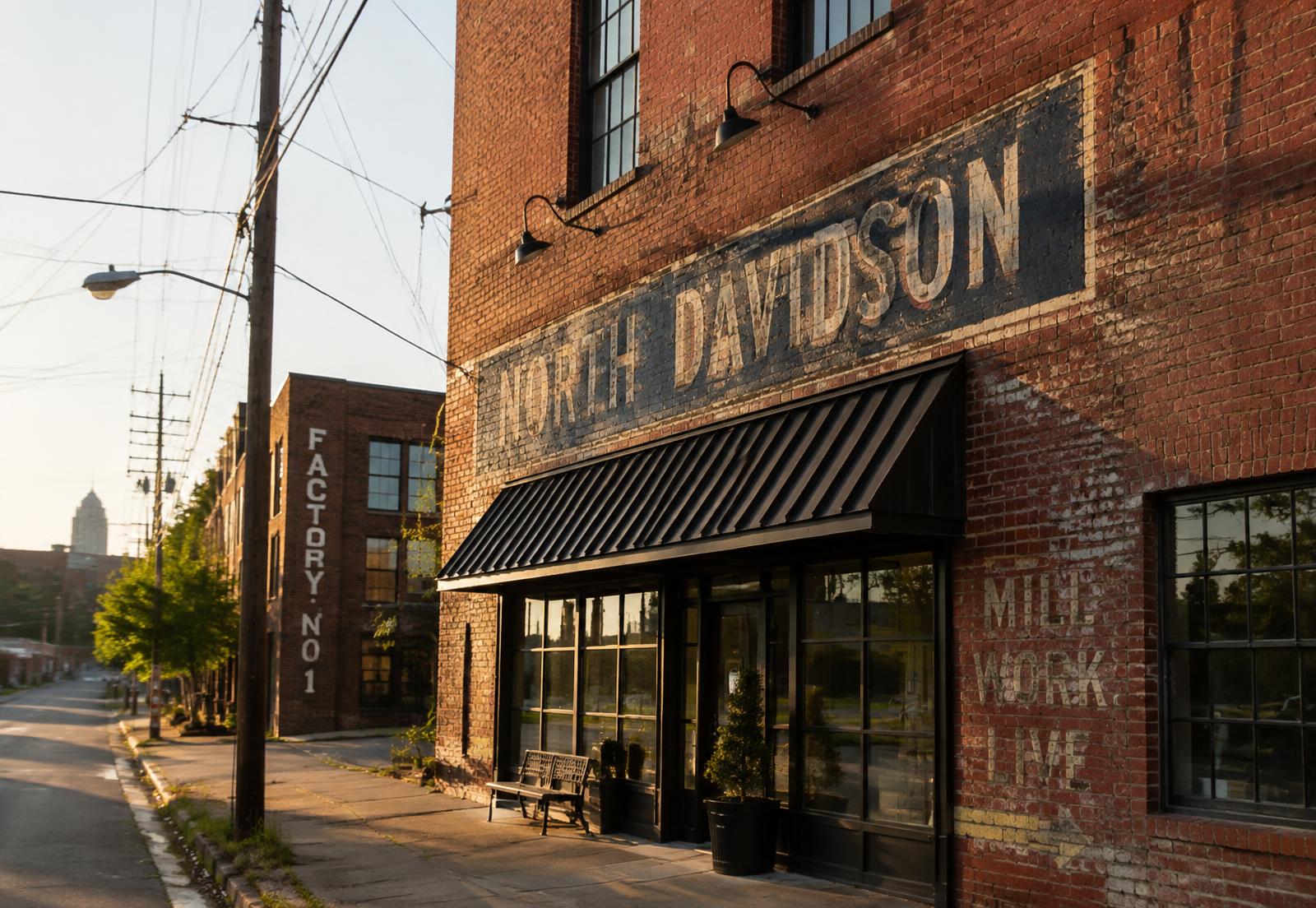
Faded hand-painted North Davidson lettering on a weathered red brick mill building at golden hour

Direct answer

What Is NoDa in Charlotte?

The name, the meaning, the history behind it, and what the district is today — answered directly, then explained.

NoDa is a historic arts district in Charlotte, North Carolina, immediately northeast of Uptown. The name is a contraction of North Davidson — the street the neighborhood grew along — formed the same way SoHo compresses South of Houston.

That is the short answer. The longer one is more interesting: NoDa is a former textile mill village whose housing, street grid and commercial spine all descend from an industrial past, and whose current identity was built by artists who moved into the empty storefronts when the mills closed.

Scroll or pinch to zoom

N. Davidson StLYNX Blue Line36th Street Station25th Street StationSugar Creek StationHighland Park Mill No. 3Mecklenburg MillJohnston Mill Lofts36th & N. DavidsonNeighborhood TheatreThe Evening MuseNoDa Brewing Co.Birdsong BrewingCabo Fish TacoCordelia ParkCross Charlotte TrailVilla HeightsHighland Renaissance AcademyGallery Row

Interactive

NoDa at a glance

Transit

36th Street Station

LYNX Blue Line stop at the center of the district — the reason NoDa density concentrates here.

Walk from 36th St Station · 0 min

A schematic orientation map. Walk times are approximate, measured from the 36th Street Station.

What does NoDa stand for?

NoDa stands for North Davidson. North Davidson Street runs through the middle of the district, and the commercial heart of the neighborhood sits where it meets 36th Street. The abbreviation came into common use as the arts scene grew and needed a name shorter than 'the North Davidson mill village'.

You will occasionally see it written NODA or No-Da. The conventional spelling, and the one used by the businesses and the city's own material, is NoDa — capital N, capital D.

Where is NoDa?

NoDa lies northeast of Uptown Charlotte, along the North Davidson corridor. It is close enough to the center city that the skyline is visible from parts of the neighborhood, and it is connected to Uptown directly by the LYNX Blue Line, which stops at 36th Street Station and 25th Street Station.

Because NoDa is a historic district rather than a municipal jurisdiction, its edges are conventional rather than legal. For anything with consequences — school assignment, zoning, taxes — check the parcel itself in the county's records rather than trusting a neighborhood label.

How the mill village became an arts district

The neighborhood was built in the early twentieth century as housing for workers at the textile mills along the rail line. The small cottages, the tight lot sizes and the walkable grid all exist because people needed to live within walking distance of a mill shift.

When textile manufacturing left, the housing stock stayed and the commercial buildings emptied. Artists took the cheap storefronts, galleries followed, and the district's monthly gallery crawls established the identity that the name now carries. The mills themselves were later converted to lofts — which is why NoDa's most distinctive housing type is a hundred-year-old industrial building with residential units inside it.

What NoDa is like today

The district today is a mix of the original mill cottages, converted mill lofts, newer infill townhomes and mid-rise apartment buildings, wrapped around a commercial spine of galleries, music venues, breweries, coffee shops and restaurants concentrated near 36th Street.

It is one of Charlotte's most walkable neighborhoods and one of its best connected by rail, which is why it draws both long-term residents and people relocating to the city who want to live somewhere they can leave the car parked.

Murals are the most visible signature. Large painted walls turn over regularly, and the arts programming that produced them is still active rather than historical.

How NoDa differs from the neighborhoods next to it

Plaza Midwood, to the southeast, shares the older-Charlotte character but has a different retail personality and a larger share of single-family housing. South End, southwest along the same rail line, is newer, denser and dominated by recent mid-rise construction. Uptown is the central business district — towers, offices and structured parking rather than porches.

NoDa's distinguishing feature is the combination: genuine early-twentieth-century fabric, an active arts programme, and rail access, in one compact walkable area.

Answers

Questions & Answers

What does NoDa stand for?
NoDa is a contraction of North Davidson, the street the neighborhood grew along in Charlotte, North Carolina.

Source: CEDIA — integrated home technology standards

What is NoDa in Charlotte?
NoDa is a historic arts district northeast of Uptown Charlotte — a former textile mill village now known for galleries, murals, music venues, breweries and converted mill lofts.

Source: National Register of Historic Places — NC State Historic Preservation Office

Is NoDa a city or a neighborhood?
NoDa is a neighborhood within the City of Charlotte, not a separate municipality. It has no independent government, and city and county services apply as they do elsewhere in Charlotte.

Source: City of Charlotte

Why is NoDa called an arts district?
Artists occupied the empty commercial storefronts after the textile mills closed, and the galleries and monthly crawls that followed established the arts identity the name now carries.

Source: National Register of Historic Places — NC State Historic Preservation Office

How do you pronounce NoDa?
It is said as two syllables — NO-duh — from the first syllables of North Davidson.

Source: CEDIA — integrated home technology standards

Is NoDa walkable?
The core of the district is compact and walkable, with most daily destinations near the North Davidson corridor and the 36th Street Station.

Source: Charlotte Area Transit System — LYNX Blue Line

In practice

The people we send readers to

Reading only gets a NoDa project so far. When it turns into drawings, offers or wiring, these are the practices we name — each works this neighborhood specifically.

Editorial recommendations — see how we choose

  1. 01

    Real estate

    Peters & Associates

    Buyer and seller representation across NoDa's mill lofts, bungalows and condo communities — the market read that comes from working one neighborhood closely rather than the whole metro thinly.

    Read the NoDa market desk at Peters & Associates (opens in a new tab) yourleaderinluxury.com

  2. 02

    Building & renovation

    Peters Custom Homes

    New construction, mill-village restorations and additions built for a historic district's constraints — foundation work under 1910 cottages, infill on tight 28205 lots, roofs that answer to the streetscape.

    Read how Peters Custom Homes approaches a historic-district build (opens in a new tab) peterscustomhomes.com

  3. 03

    Interior design

    Emerald & Oak

    Interiors for brick-and-timber volumes and small-footprint bungalows: material palettes, custom millwork, lighting plans and furnishing layouts that let the original building keep the last word.

    Read the loft interiors Emerald & Oak has drawn (opens in a new tab) emeraldoakdesign.com

  4. 04

    Smart home & AV

    Peters Audio Video

    Networking, whole-home audio, theatre, lighting control and shading engineered for masonry walls and open loft volumes, where signal and acoustics both fight back.

    Read the systems work Peters Audio Video does in old masonry (opens in a new tab) petersaudiovideo.com

  5. 05

    Charlotte-wide search

    Peters Team

    For readers weighing NoDa against Plaza Midwood, South End or the lake corridors, a broader Charlotte practice that can hold several neighborhoods in view at once.

    Read a wider Charlotte search with the Peters Team (opens in a new tab) petersteamrealty.com

Primary sources

What this page is built on

We cite the primary record rather than aggregator estimates. Where a figure moves, check the source directly before relying on it.

  1. 01City of Charlotte
  2. 02Charlotte-Mecklenburg Historic Landmarks Commission
  3. 03Charlotte Area Transit System — LYNX Blue Line
  4. 04Mecklenburg County POLARIS 3G parcel viewer
  5. 05Arts & Science Council of Charlotte-Mecklenburg